
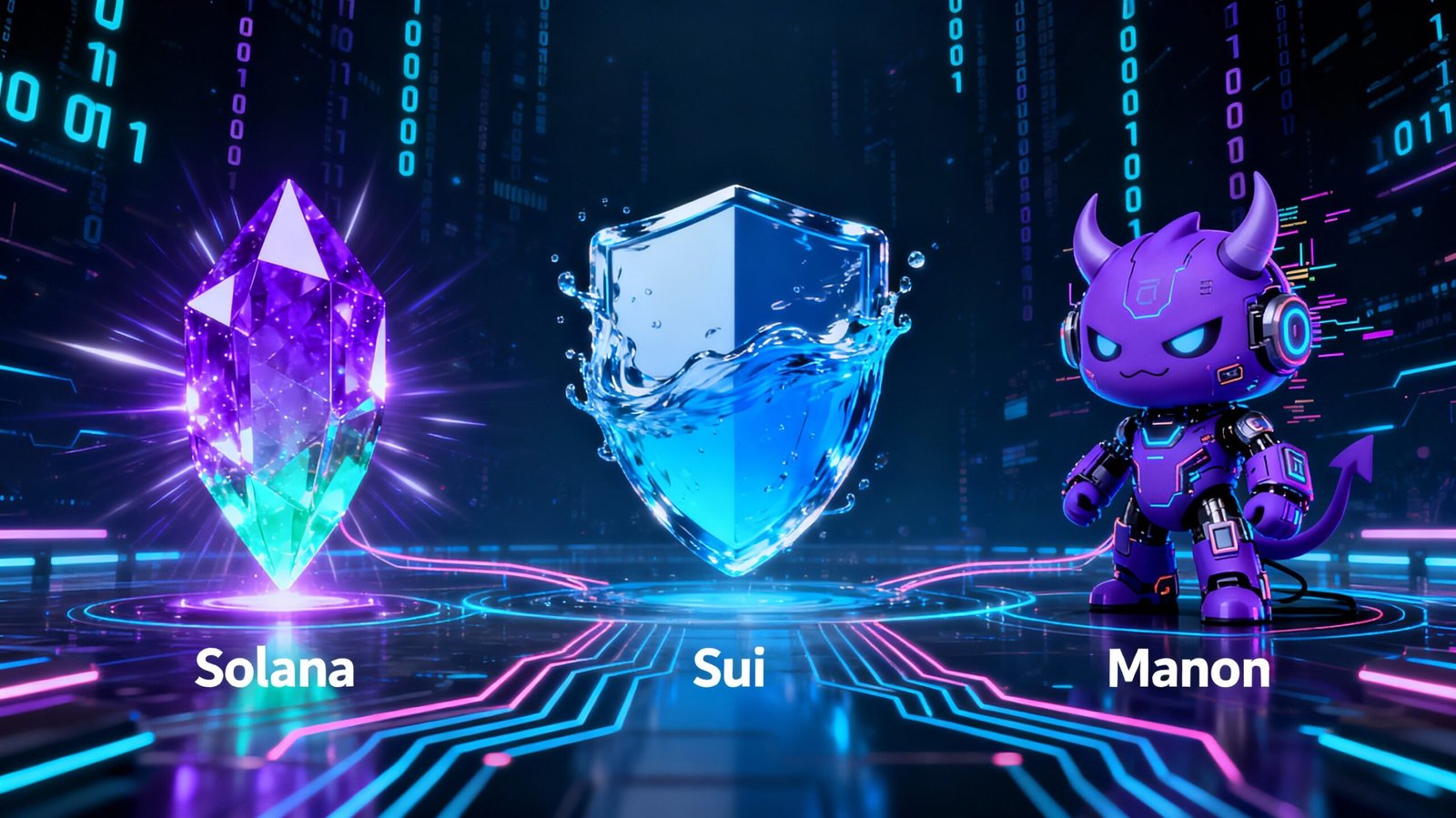
Solana vs Sui vs Monad: The cryptocurrency market is cyclic, and as we look toward 2026, the battle for dominance among Layer-1 (L1) blockchains is fiercer than ever. While Ethereum remains the giant, the race for speed, scalability, and low fees has produced three titans: Solana (SOL), Sui (SUI), and the highly anticipated Monad (MON).
For investors and developers, the big question is: Who will win the L1 war in 2026?
In this guide, we break down the technology, ecosystem, and investment potential of these three chains to help you decide where the smart money is flowing.
1. Solana (SOL): The Resilient Giant
Solana has solidified its position as the “people’s chain” during the 2024-2025 cycle. Having survived the FTX collapse, it is currently the undisputed king of high-speed transactions and the home of the meme coin supercycle.
Why Solana Could Win in 2026:
- Firedancer Upgrade: This is Solana’s ace in the hole. Firedancer is a new validator client that aims to increase theoretical throughput to 1 million TPS (Transactions Per Second). If fully operational by 2026, Solana becomes virtually uncatchable in terms of raw speed.
- DePIN Dominance: Projects like Helium and Hivemapper have chosen Solana, making it the hub for Decentralized Physical Infrastructure Networks (DePIN).
- Sticky Ecosystem: With Phantom Wallet and massive liquidity, users are comfortable here.
The Risks:
- Network Reliability: While outages have decreased, they haven’t disappeared completely.
- Centralization: Critics often point to the cost of running a validator node as a barrier to true decentralization.
2. Sui (SUI): The Technologist’s Choice
Built by former Meta (Facebook) engineers using the Move programming language, Sui is often called the “Solana Killer.” It focuses on object-centric architecture, making it distinct from almost every other chain.
Why Sui Could Win in 2026:
- Superior Technology: Sui’s object-centric model allows for true parallel execution. Unlike Solana, which processes transactions in a sequence, Sui can process unrelated transactions simultaneously without congestion.
- Gaming Focus: Sui is positioning itself as the Global Gaming Layer. By 2026, as Web3 gaming matures, Sui’s sub-second finality makes it the best candidate for on-chain games.
- Developer Safety: The Move language is designed to prevent common smart contract bugs (like reentrancy attacks) that plague Solidity-based chains.
The Risks:
- Tokenomics: Sui has a heavy unlocking schedule, which can create selling pressure (inflation) on the token price.
- Developer Barrier: Developers must learn ‘Move’, which is harder than just copying code from Ethereum.
3. Monad (MON): The Holy Grail (Parallel EVM)
Monad is the most hyped project entering late 2025/2026. Its value proposition is simple yet revolutionary: The speed of Solana with the compatibility of Ethereum.
Why Monad Could Win in 2026:
- Parallel EVM: This is the narrative of the year. Monad allows developers to use Ethereum tools (Metamask, Etherscan, Solidity) but runs them at Solana-like speeds (10,000+ TPS).
- Easy Migration: Unlike Sui, where devs need to learn a new language, Ethereum developers can move their apps to Monad instantly. This could lead to rapid ecosystem growth in 2026.
- Community Cult: “The Gnar” (Monad’s community) is arguably as loud and dedicated as the early Solana community.
The Risks:
- Execution Risk: As of late 2025, Monad is still the “new kid.” Mainnet stability is unproven compared to the battle-tested Solana.
- Vaporware Concerns: Until the ecosystem is fully live, high valuations are based on speculation rather than revenue.
Comparison Table: The Technical Face-Off
| Feature | Solana (SOL) | Sui (SUI) | Monad (MON) |
|---|---|---|---|
| Core Tech | Proof of History (PoH) | Object-Centric (Move) | Parallel EVM |
| Throughput (TPS) | 65,000+ (Theory) | 297,000+ (Theory) | 10,000+ (Target) |
| Language | Rust | Move | Solidity (EVM) |
| Key Narrative 2026 | Firedancer & DePIN | Web3 Gaming & Tech | ETH Compatibility + Speed |
| Risk Level | Moderate | Medium-High | High (New Entrant) |
Final Verdict: What Should You Buy for 2026?
The answer depends on your investment style:
- The “Safe” Bet: Solana (SOL)
If you believe crypto will go mainstream in 2026, Solana is the safest infrastructure play. It has the users, the apps, and the liquidity. It is the “Apple” of crypto. - The “Growth” Bet: Sui (SUI)
If you are bullish on Web3 Gaming, Sui is the leader. If a major game goes viral in 2026, SUI could outperform SOL in percentage gains. - The “High Risk/High Reward” Bet: Monad (MON)
Monad is the shiny new object. If it successfully delivers 10,000 TPS with full Ethereum compatibility, it could siphon liquidity from both Ethereum and Solana. This is the play for the “100x” hunters.
Conclusion
The “Layer-1 Wars” are not over; they have just evolved. 2026 will likely see a multi-chain future where Solana powers consumer apps, Sui powers gaming, and Monad powers high-frequency DeFi. A diversified portfolio holding all three might be the smartest strategy for the coming bull run.
Frequently Asked Questions (FAQ)
Q: Is Monad a Solana killer?
A: Monad competes with Solana on speed but targets Ethereum developers. It threatens Ethereum’s L2s more than it threatens Solana directly.
Q: Can Sui overtake Solana in 2026?
A: It is possible if the gaming sector explodes. However, Solana currently has a massive lead in daily active users and liquidity.
Q: When is the Monad airdrop?
A: While rumors exist, always check official channels. Engaging with the Monad testnet is the best way to qualify for potential future rewards.
Disclaimer: This article is for informational purposes only and does not constitute financial advice. Cryptocurrency investments are highly volatile.